“Playing with food might be unacceptable to some, but with purpose and guidance, it allows her little brain to bloom.”
Text/Jacqueline Ho
Image/Rooftop Institute
Fussy eaters, messy eaters, picky eaters are everywhere. When you have a kid, never take peaceful mealtime for granted. The parent-child workshop, Eat It, designed by an artist to transform mealtime into a delightful adventure, was both well thought out and well executed. Jasmine (my three-year-old) and I had a fantastic afternoon, legitimately playing with food, creating unique recipes for the kids to try a wider variety of foods, and devouring all the ingredients more than usual!
I am grateful to be a mum of two and an educational psychologist meeting kids ranging from primary to secondary schools on a regular basis. It is a pleasure to witness how each individual is shaped by their unique life experiences and interactions with diverse personalities. People approach the same problem differently, influenced by the resources available to them. These resources include not only physical and human support but also prior knowledge, various skill sets—such as cognitive, social, emotional management skills—and creativity. For example, different parents strive to provide their children with balanced meals and apply their own skills. My mother-in-law is an excellent cook; when my husband was a picky eater as a child, she tried a variety of dishes to see what he would enjoy. Eventually, she discovered that dumplings, packed with meat, vegetables, and carbs, were the perfect solution. Here in this workshop, Wendy used another approach.
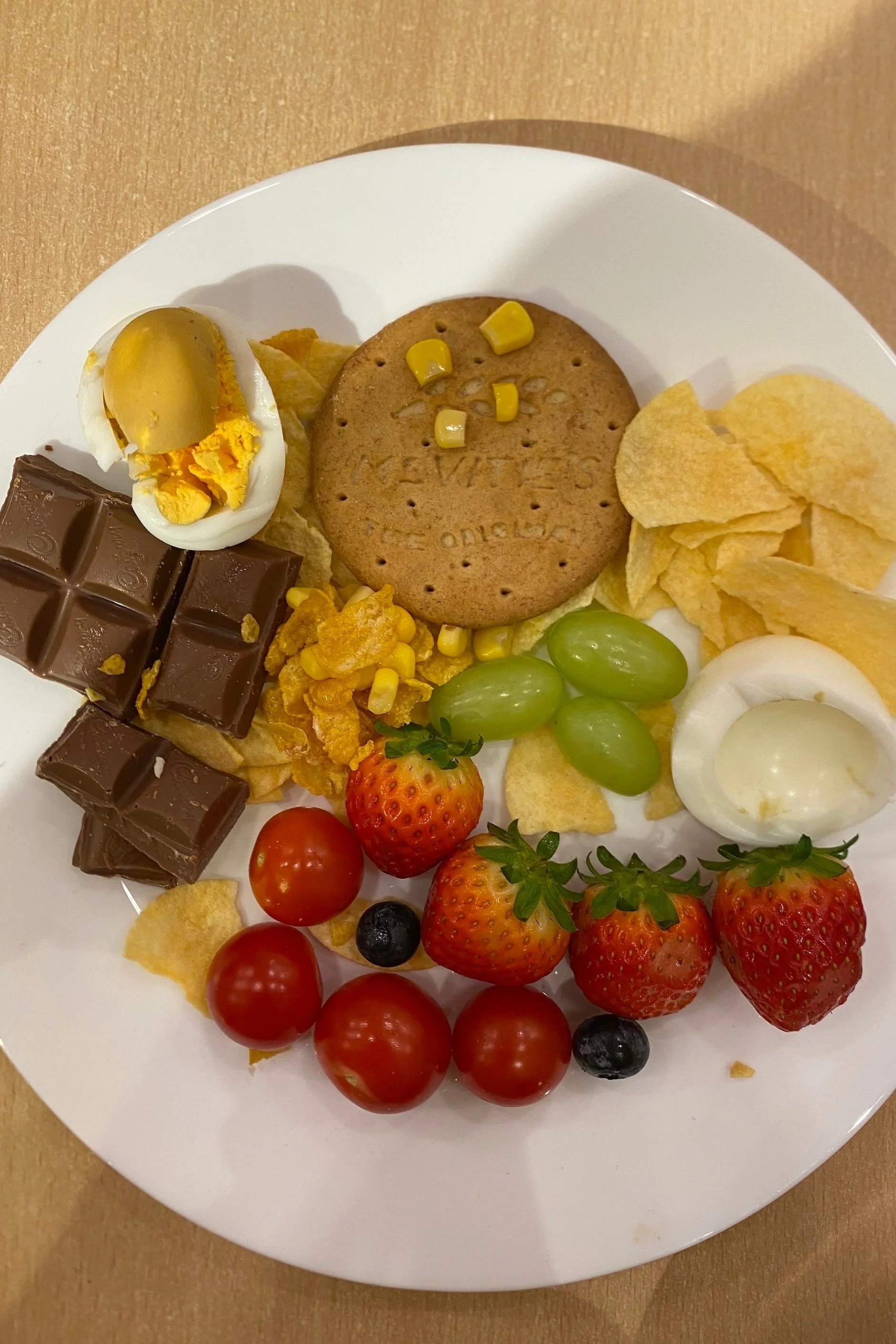
This 2-hour session was separated into two parts. Parents were instructed for the first round to pick food ingredients prepared by the team. We were to turn them into an art piece to increase the appetite of the child. Knowing that Jasmine loved rabbits, I crafted a rabbit face out of lean chicken meat, with carrot sticks as its long ears, and two blueberries as eyes. I added a boiled egg in the background as the sun, and a seaweed rice ball as the playground mat. Jasmine enjoyed every bite. She didn’t normally eat that much, but the fun experience made it exceptional. For the second round, the kids were given the autonomy to do the same, creating a dish for their parents. There was a parent-child role reversal, and the kids were in the position to decide what their parents would eat. Jasmine was truly a fish in the water as she was quite an assertive (bossy) girl. She knew exactly what she wanted. unsurprisingly, Jasmine gravitated towards all the “forbidden” food — plenty of crisps and chocolate. As she had fun crushing the crisps, I asked her if she was turning them into sand. She quickly responded that she was building a sandcastle, and right at that moment, she decided the theme of her art piece to be “sandcastle at the beach.” she also scraped all the egg yolk out from another boiled egg (because she did not like it) and declared it the moon. She took my idea of using the egg as the sun and further developed it in her food art.
It dawned on me how our creative ideas as parents can unintentionally spark our kids' imaginations. This 2-hour workshop illuminated the importance of adopting an artist mindset in parenting and early education. Our curiosity and open-mindedness empower our children to embrace this mindset, nurturing their creativity. Should I have stopped Jasmine from crushing the crisps at that point because it was socially unacceptable to play with food, it would have crushed her creative expression and our parent-child relationship. Instead, when I chose to ask/suggest her what it could be, it opened up a window for mutual respect and shared exploration to happen.
On an individual level, creativity fosters personal fulfillment and leads to positive academic and professional outcomes, serving as a therapeutic outlet as well. Jasmine, at the age of three, delights so much in multi-sensory play and takes pride in things she creates. Playing with food might be unacceptable to some, but when it is allowed occasionally with a specific purpose and parental guidance, it is permitting her little brain to bloom with these artistic activities. Beyond these personal benefits, creativity has profound implications for society. It drives innovation and advances humanity (Weir, 2022). moreover, creativity plays a crucial role in building resilience (Davis, 2020). one of the most alarming trends is that younger generations appear to be increasingly emotionally vulnerable. Creativity enhances our capacity to connect abstract ideas and develop innovative solutions, which in turn strengthens our problem-solving skills and resilience. By introducing an artist mindset that nurtures creativity in early childhood, we are significantly increasing our children's chances of thriving in an ever-changing, stressful environment that demands resilience. Never underestimate the impact of each creative exploration with our kids. these two hours of quality time with Jasmine were indeed well spent.
Weir, K. (2022). The science behind creativity. Monitor on Psychology, 53(3), 40. https://www.apa.org/monitor/2022/04/cover-science-creativity
Davis, J. (2020). How creativity builds resilience in times of crisis. Psychology Today. https://www.psychologytoday.com/us/blog/tracking-wonder/202006/how-creativity-builds-resilience-in-times-crisis/amp
***
Jacqueline Ho, Educational Psychologist
***